
Eight hundred metres below the surface, inside a coal seam or a half-bored tunnel, something simple stops working: the signal.
No mobile network. No Wi-Fi. No cloud. And with it goes every assumption modern safety technology is built on — that a wearable can stream data upward, that an app will raise an alarm, that someone at the surface knows where each worker is standing right now.
In practice, this is what a control room often has to work with: a paper attendance register, a radio check every few hours, and a headcount that becomes accurate only after everyone walks back out.
The cost of that gap is measured in minutes. In a roof fall, a gas pocket, a blast misfire, or a heat-stress collapse, the first fifteen minutes decide the outcome. If the control room learns about an incident only when a worker fails to report at shift end, the rescue has already started late.
The same gap exists on a forward post at high altitude, in a tunnel-boring operation, and inside a confined-space maintenance job. Different industries — identical blind spot.
Why cloud-first wearables fall short here
Consumer and industrial wearables have improved dramatically. Most of them, however, share one architectural assumption: the intelligence lives in the cloud. The band measures, the phone relays, the server decides.
Underground, that chain breaks at step two.
What these environments need is the opposite design — a device that can think for itself, decide locally that something is wrong, and get a short, high-priority message out through whatever thin channel still exists. Not a device that goes silent the moment coverage drops.
That inversion is the design principle behind HVIS.
What HVIS is
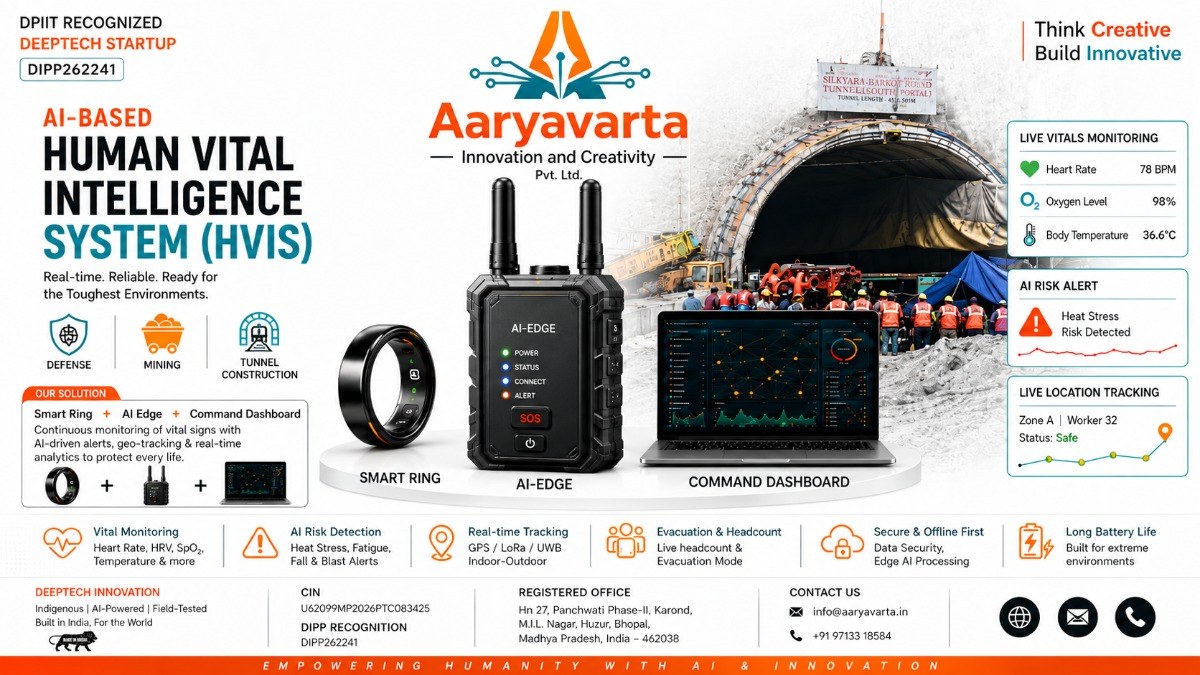
HVIS — the AI-Based Human Vital Intelligence System — is a three-part safety platform designed for underground mining, tunnel construction, and defence deployments.
1. Smart Ring — the sensor on the person
A ring, not a jacket-mounted box. It is worn continuously without getting in the way of gloves, harnesses, helmets, or tools — which is precisely why it actually stays on the finger through a full shift.
It continuously tracks:
- Heart rate and heart-rate variability (HRV)
- Blood oxygen saturation (SpO₂)
- Skin and body temperature
- Motion, posture, and fall signatures via a 9-axis IMU
2. AI-Edge Unit — the intelligence in the field
Roughly walkie-talkie sized and built to be carried or mounted, the AI-Edge unit is where the decision-making happens. AI inference runs on the device itself, not on a distant server.
It handles:
- On-device risk models (TinyML) for fall detection, health anomalies, and blast/impact events
- Multi-layer positioning: GPS and barometer outdoors, UWB and BLE indoors, fused with IMU data
- Multi-channel connectivity: LoRa mesh, device-to-device relay, BLE 5.x, Wi-Fi, and 4G LTE where available
- A physical SOS control for the worker who needs help before any algorithm notices
Because the analysis is local, an alert is generated even when the link to the surface is degraded or intermittent. Connectivity is used to transmit a decision, not to make it.
3. Command Dashboard — the picture at the surface
The control room sees a live view instead of a register:
- Live vitals per worker
- AI risk alerts — heat stress, fatigue, fall, impact — with the context behind each one
- Zone-wise location and movement history
- Live headcount and an evacuation mode that shows who is out and who is still inside
- Shift-level analytics and exportable reports for compliance and safety review
The six capabilities that define the system
| Capability | What it means on site |
| Vital monitoring | Continuous HR, HRV, SpO₂ and temperature — not a spot check at the gate |
| AI risk detection | Heat stress, fatigue, fall and blast events flagged as they develop |
| Real-time tracking | GPS, LoRa and UWB working together across indoor and outdoor zones |
| Evacuation & headcount | Live count and per-worker status the moment an evacuation is called |
| Secure, offline-first | Edge AI processing; data stays local by default |
| Long battery life | Built for full shifts in extreme temperature and humidity |
Where HVIS fits
Mining. Underground coal and metal mines, where DGMS-driven safety obligations meet an environment that defeats conventional connectivity.
Tunnel construction. Metro, highway, and hydro tunnels, where the working face advances daily and the safety perimeter moves with it.
Defence. Soldier vitals and location awareness in terrain where infrastructure cannot be assumed and data sovereignty is non-negotiable.
The common thread across all three: high-risk work, poor connectivity, and a heavy penalty for delayed information.
Where we are today — stated plainly
We believe a safety company should be precise about its own status, so here it is without embellishment.
Aaryavarta Innovation and Creativity Pvt. Ltd. is a DPIIT-recognised DeepTech startup (DIPP262241), incorporated in 2026 and based in Bhopal, Madhya Pradesh.
HVIS is at TRL 3–4. The Smart Ring exists as a functional bench prototype. The system architecture — positioning stack, connectivity layers, on-device models, and the gateway-to-dashboard framework — is designed and documented. Integration and field validation are the work ahead of us, not behind us.
We are currently seeking pilot partners in mining, tunnelling, and defence, along with grant, incubation, and CSR support to accelerate that validation. If you operate in one of these environments, a pilot conversation with us is a conversation with the engineers building the system — not a sales layer in front of them.
Built in India, for the world
HVIS is designed and developed indigenously. For defence and critical-infrastructure users, that is not a slogan — it is a supply-chain and data-sovereignty requirement, and it is why the system is offline-first by architecture rather than by configuration.
Every shift underground carries an implicit promise: everyone who walks in, walks out. HVIS exists to make that promise measurable.