
17 Days in the Dark
What Silkyara Taught Us About Underground Worker Safety
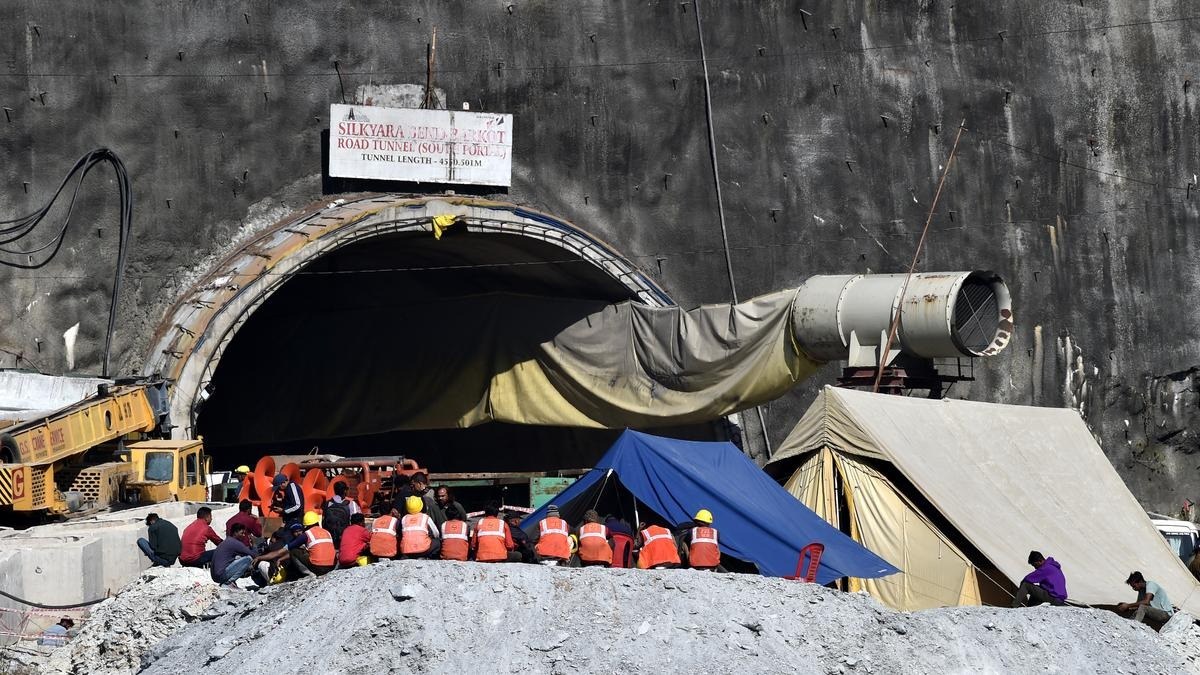
It was around 5:30 in the morning on 12 November 2023 — Diwali. Inside the under-construction Silkyara Bend–Barkot tunnel in Uttarkashi, Uttarakhand, the night shift was winding down. Then roughly 60 metres of the tunnel crown came down.
Forty-one men were on the wrong side of that rubble.
What followed was seventeen days that the entire country watched. And what followed after that — the investigation reports — is the part most people never read. That second part is why we are writing this.
What actually happened
The Silkyara–Barkot tunnel is a 4.5 km link on the Char Dham corridor, meant to cut the journey to Yamunotri and remove the seasonal bottleneck at Radi Top. It was being built by Navayuga Engineering under NHIDCL.
The collapse occurred roughly 200 metres in from the portal. The workers were trapped deeper inside, with a wall of rock, soil and twisted steel between them and daylight. Nobody outside knew, in those first hours, exactly how many men were in there, where inside they were, or whether any of them were injured.
The rescue became a national mobilisation. NDRF, SDRF, ITBP, NHIDCL, ONGC, RVNL, THDC, the local police — over a dozen agencies, hundreds of personnel, and international tunnelling experts. It was also a study in things going wrong:
- A 6-inch pipe was pushed through the debris early on. This became the lifeline — oxygen, food, medicines, and eventually a walkie-talkie link and a camera. It is the single reason the story has a happy ending.
- The main plan — driving an 800–900 mm steel escape pipe horizontally through roughly 57 metres of debris — kept stalling. The auger machine hit buried steel girders and construction vehicles inside the rubble and finally snapped.
- A parallel vertical drill was started from the hillside above, nearly 90 metres down, through ground that had already proved unstable.
- The final stretch was cleared by hand. A team of rat-hole miners crawled in with hand-held tools and dug through the last few metres of rubble.
On the evening of 28 November, all 41 men came out. No fatalities. It remains one of the most impressive rescue efforts in Indian engineering history.
But a rescue is what you do when prevention and preparedness have already failed.
The part that should worry us
Multiple investigations followed. The findings were blunt.
The tunnel alignment ran through a shear zone — a band of rock weakened by tectonic movement, extremely common in the young Himalaya and extremely dangerous to tunnel through without heavy precaution. The presence of shear zones had been flagged in the geotechnical interpretative report. A government panel found that bid parameters had been finalised without adequate geotechnical investigation, that the DPR rested on limited geological survey work, and that no advance probing or measurement techniques were proposed or found on site. One report noted the site had gone roughly twelve months without a resident geologist.
There had been around 21 collapses and cave-ins at this tunnel in the four years of construction before 12 November. Twenty-one warnings.
The mandated escape passage was missing. Tunnel guidelines require a parallel escape tunnel for any bore longer than 1.5 km. The tender documents and the DPR both referenced it. It had not been built.
And one finding, small in the reports but enormous in its implications, sits at the centre of everything we do at Aaryavarta:
There were no sensors or monitoring equipment inside the tunnel.
Think about what that meant in practice on that Diwali morning. The moment the crown fell, the men inside stopped existing as data. Not as people — as data. Rescuers spent the first critical hours working from a headcount, not a system. How many? Unknown until the muster roll was cross-checked. Where inside the 2-km-plus bore were they? Unknown. Alive? Unknown for a day and a half, until the compressed-air pipe carried a voice back.
In every underground emergency, the first six to twelve hours decide the shape of the entire operation. At Silkyara those hours were spent establishing facts that a monitoring system should have been streaming continuously.
How we think about this at Aaryavarta
Let us be straightforward about one thing first, because the alternative is the kind of marketing that this subject does not deserve: we are not claiming that our technology would have prevented the Silkyara collapse. A collapse caused by alignment through a shear zone, thin geological investigation and a missing escape passage is a design-and-governance failure. No wearable fixes that.
What a system like ours changes is the other half of the problem — the part between "the ground failed" and "we found them."
HVIS — our AI-Based Human Vital Intelligence System — is built around a single design assumption drawn directly from incidents like this one: when things go wrong underground, the network goes first. Power fails. Backhaul is cut. Cloud connectivity is a fantasy 200 metres into a Himalayan mountain. Any safety system that depends on a live uplink to be useful is a safety system that switches off exactly when it is needed.
So the architecture is built the other way around:
1. Vitals at the source. A Smart Ring worn by each worker continuously tracks physiological signals — heart rate, SpO₂, skin temperature, motion. Not a checklist at shift start. A live signal, per person, for the whole shift.
2. Intelligence at the edge, not in the cloud. Fall and impact detection, vitals anomaly detection and distress classification run on the device and the local Edge Unit. If the tunnel loses all external connectivity, the system does not go blind — it keeps monitoring, keeps logging, and keeps alerting locally.
3. Location where GPS does not exist. This is the hardest technical problem in the stack and the one we care most about. Underground, satellite positioning is worthless. We combine UWB anchors, barometric altimetry and inertial dead reckoning to maintain a position estimate for every worker along the bore. The objective is that a control room can answer, within seconds of an incident: how many people are past the collapse point, who are they, and roughly where.
4. Environmental context. Gas concentration, temperature, humidity — read alongside human vitals, so a rising CO level and a falling SpO₂ are seen as one event rather than two unrelated readings on two different screens.
5. Last known state, preserved. When a link drops, the last transmitted vitals and position for every worker persist at the Edge Unit and the Command Dashboard. The rescue effort starts from a record instead of from a rumour.
That is the difference we are working toward. Not preventing a mountain from moving — nobody can promise that. Reducing the hours between a collapse and an informed, targeted rescue plan, and making sure the incident is seen the moment it happens rather than at the next headcount.
Where we actually are
Aaryavarta Innovation and Creativity Pvt. Ltd. is a DPIIT-recognised DeepTech startup based in Bhopal, incorporated in 2026. We are early. The Smart Ring exists as a functional bench prototype; the Edge Unit and Command Dashboard are in active development. We have not deployed at a live site yet.
We are saying that plainly because the underground safety space has enough overpromising in it already, and because the people who have to trust this equipment work in conditions where an oversold product is not a customer service problem — it is a body count.
What we are looking for now are pilot partners: tunnel contractors, underground mine operators and defence formations willing to run HVIS alongside their existing safety protocols and tell us honestly where it breaks. Real dust, real heat, real shift lengths, real network dead zones. That is the only way this gets good enough to matter.
The 41
They came out. Twenty-one earlier collapses at that site did not kill anyone either. Somewhere in India tonight, a shift is underground in a tunnel that has had its own share of warnings.
The men in Silkyara were fortunate that a 6-inch pipe went in early, that the rat-hole miners existed, and that a country decided to care for seventeen days. Fortune is not a safety system.
Building the one that does not rely on it is the work.
Aaryavarta Innovation and Creativity Pvt. Ltd. is building HVIS, a wearable Edge AI safety platform for defence, underground mining and tunnel construction. If you operate an underground site and want to discuss a pilot, we would like to hear from you.
Sources: Ministry of Road Transport and Highways expert committee investigation report on the Silkyara Bend–Barkot tunnel incident; government panel findings on project lapses (2025); contemporaneous reporting by BBC, PTI, NPR and The Tribune on the November 2023 rescue operation.